Food Labels

Food labels, also known as nutrition facts labels, give information about the composition of a type of food and are found as a label printed on the food package (Figure 1). Besides stating the number of calories, the amount of fat, cholesterol, carbohydrates, protein and other supplements, it also gives instructions about the percentage of the recommended daily value.
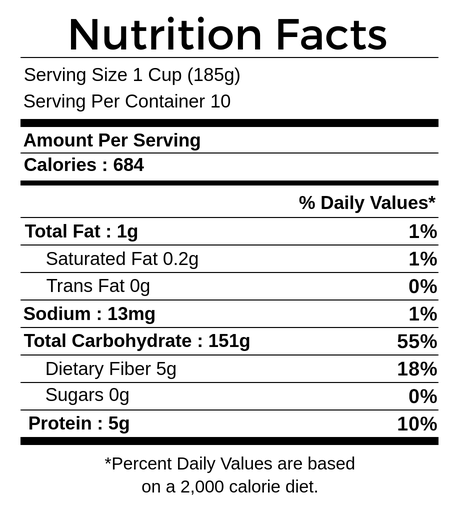
This image shows an example of a nutrition facts label. The label starts at the top with the heading that says Nutrition Facts. Directly below, it defines the unit of measurement for all the data that follows. The serving size is 1 cup which weighs 185 grams. There are 10 servings in the entire container. Under the Amount Per Serving section, the Calories are listed as 684. This represents the total chemical energy available to the body through the metabolism of the macronutrients in one serving. Below that, the macronutrient contents are listed. Their masses are provided along with a Percent Daily Value, or DV, which is based on a standard 2000 calorie daily diet. The total fat content is 1 gram, which represents 1% of DV. This is further broken down into 0.2 grams of saturated fat and 0 grams of trans fat. The sodium content is 13 milligrams, which is 1% of DV. The total carbohydrate is 151 grams, which represents 55% of DV. It also includes 5 grams of dietary fiber, which is about 18% of DV, and 0 grams of sugar. The final nutrient is protein, in about 5 grams, which represents about 10% of DV.

Figure 1: Nutrition facts label on a package of rice