Injecting Insulin

Supplies used for injecting insulin with a syringe include a vial of insulin, a sterile insulin syringe, alcohol wipes, and a container for sharps.

This image shows an example of an insulin vial and a syringe that will be used to inject it into the body

Figure 1: Insulin vial and syringe

Three regions are most suitable for insulin injection, namely upper arms, abdomen (or stomach), and thighs (Figure 2). Most commonly, insulin is injected in the abdomen.
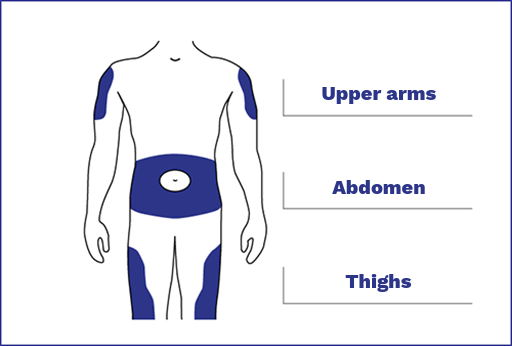
This image provides a visual guide for identifying the primary subcutaneous injection sites on the human body. These are areas where medicine can be safely injected into the fatty tissue layer just beneath the skin. The diagram features an outline of a human torso and limbs, with three specific regions highlighted in dark blue. The first one is upper arms. The highlights are located on the outer, posterior or back aspect of both the left and right upper arms, between the shoulder and the elbow. The second one is abdomen. A wide band is highlighted across the stomach area. It covers most of the abdominal region but specifically leaves a circular clear space around the navel, or belly button. The last one is thighs. The highlights are positioned on the front and outer sides of both the left and right thighs, extending from just below the hip to above the knee. Each of these highlighted areas is labeled with text to the right of the figure, using thin lines to point directly to the corresponding body part. These sites are chosen because they typically contain a sufficient layer of fat and are easily accessible for self-administration.

Figure 2: Insulin injection sites